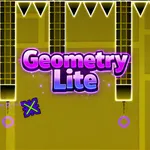





Geometry Lite
Geometry Lite: A Masterclass in Reflexive Precision
| Attribute | Specification |
|---|---|
| Developer | RobTop Games |
| Genre | Rhythm-based Platformer |
| Primary Input | Single-Click / Tap |
| Failure State | Instant Restart |
Stepping into the world of Geometry Lite feels like walking onto a high-wire act where the floor is made of jagged edges. This title strips away the unnecessary bloat found in modern gaming, leaving only the raw, pulsating core of platforming challenge. Every movement in Geometry Lite is dictated by a singular, persistent forward momentum that demands your undivided attention.
At its heart, Geometry Lite serves as a brutal teacher. You are not meant to breeze through these levels on your first attempt. Instead, the game invites you to embrace the inevitable failure that comes with learning complex, rhythmic patterns. When you engage with Geometry Lite, you are essentially training your nervous system to respond to visual cues before your conscious brain can even process them.
The Illusion of Safety
Early stages in Geometry Lite lull players into a false sense of security with slow, predictable pacing. The music syncs perfectly with the obstacles, creating a flow state that feels almost meditative. However, this is a calculated design choice meant to lower your guard before the difficulty spikes.
Veteran players recognize this pattern immediately. Geometry Lite uses these calm moments to establish a baseline rhythm, only to introduce off-beat hazards that punish those who rely solely on instinct. If you find yourself dying repeatedly, it is because Geometry Lite is teaching you to look past the surface-level movement and internalize the underlying beat.
Pro-tip: Do not look at your character. Focus your gaze on the center of the screen to identify upcoming obstacles in Geometry Lite before they arrive.
Navigating Hidden Hazards
The true challenge of Geometry Lite lies in the deceptive placement of spikes and portals. As you progress, the game introduces gravity-flipping mechanics that force you to re-evaluate your orientation mid-jump. Mastering these transitions is the only way to conquer the later levels of Geometry Lite.
Consider the following mechanics that define your experience:
- Timed Input: Every click in Geometry Lite must be synchronized with the background audio track.
- Gravity Wells: These portals invert your vertical axis, requiring a complete shift in your jumping logic.
- Memory Blocks: Certain obstacles in Geometry Lite are designed to obscure your path, forcing you to memorize the layout.
- Momentum Retention: Maintaining your speed through transition zones is critical for clearing wide gaps.
When you encounter a particularly difficult section in Geometry Lite, the best approach is to break it down into manageable segments. Don't try to clear the whole level at once. Focus on the specific jump that kills you, and repeat that small interaction until it becomes muscle memory.
Building the Muscle Memory
Success in Geometry Lite is rarely about raw reaction speed; it is about the accumulation of knowledge. Each death provides a data point, showing you exactly where your timing failed. By treating every run as a learning opportunity, you eventually turn the chaotic stages of Geometry Lite into a choreographed performance.
Many players mistake this process for frustration, but it is actually a form of deep focus. When you are fully immersed in Geometry Lite, the rest of the world fades away. The only things that exist are your input device and the rhythmic movement of the geometric shape on your screen.
This cycle of trial and error is what gives Geometry Lite its unique replayability. Even after you have mastered a level, the rush of executing a perfect run remains just as potent. It is a testament to the design philosophy of Geometry Lite that such a simple premise can offer such enduring satisfaction.
Frequently Asked Questions About Geometry Lite
How do I improve my timing when the music gets fast?
The secret to surviving high-speed sections in Geometry Lite is to rely on the visual rhythm of the obstacles rather than the music alone. As the tempo increases, focus on the spacing between hazards. If you calibrate your jumps to the beat, you will find that the game naturally guides your fingers into the correct timing.
Why does my character keep hitting the same spike?
You are likely jumping too early or too late due to a lack of input consistency. In Geometry Lite, holding the button down can sometimes lead to unintended double jumps. Try to use short, crisp taps to ensure your character clears the obstacle without overshooting the landing zone.
Ultimately, Geometry Lite remains a benchmark for the genre because it refuses to compromise on its core mechanics. Whether you are a casual player looking for a quick distraction or a hardcore enthusiast chasing the perfect run, Geometry Lite provides a platform that is as fair as it is unforgiving. Keep practicing, stay patient, and remember that every death in Geometry Lite is simply a step closer to mastery.